Giant nonlinearities of emitters highly coupled to light
Quantum nanophotonics blends expertise in solid-state physics and optics, allowing highly coherent quantum dots (quasi-perfect two-level systems) to be strongly coupled to light through high-quality nanophotonic structures.
Previous activity: Hanna’s postdoctoral work at the Niels Bohr Institute (group of Pr. Peter Lodahl).
Quantum nanophotonics
Quantum nanophotonics blends two disciplines: expertise in solid-state physics and in optics. Such a combination allows, for example, highly coherent quantum dots (assimilated to simple, quasi-perfect two-level quantum systems) to be highly coupled to light through high-quality nanophotonic structures such as cavities, photonic crystals, or even simple waveguides.
This efficient interaction between light and matter enables coupling probabilities close to unity between each single photon and a quantum emitter. This results in very efficient and coherent light–matter interactions that allow the observation of phenomena such as the quasi-deterministic generation of single photons, spin–photon entanglement, as well as giant nonlinearities, so called because they exhibit sensitivities at the single-photon level. An example is the single-photon saturation of a two-level emitter.
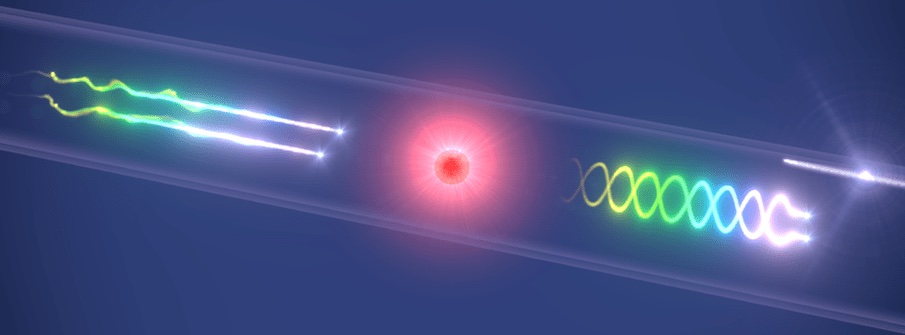
When photons are sent to a two-level quantum scatterer, interference occurs between the input field and the field scattered by the emitter, causing single photons to be reflected. By varying the laser frequency, one can observe an extinction of the transmission at resonance: the higher the light–matter coupling, and the more ideal the single emitter, the more single photons get reflected.
A transmission dip of 10%, sensitive at the single-photon level, was first demonstrated by the Lodahl group in 2015. By working on new structures and stabilizing the charge environment around the quantum dot, near-perfect “two-level atoms” were achieved, with transmission extinctions of 50% in waveguides and 80% in photonic crystals, still saturable at the single-photon level. These structures can already be used as quantum photon switches.
These nonlinearities can also be used to create photon sorters: single photons are reflected, while photon pairs are transmitted. Experimental schemes to create CZ quantum gates or Bell-state analyzers have already been proposed. For all this, it is necessary to understand and analyze the behavior of multiphoton quantum states, which are much more complex: this work included modelling the action of a two-level emitter on two-photon states and implementing an experiment to detect such a response, leading to the experimental reconstruction of the few-photon nonlinear scattering matrix from a single quantum dot in a nanophotonic waveguide (Physical Review Letters, 2021) and the observation of dynamical photon–photon interaction mediated by a quantum emitter (Nature Physics, 2022).