Hybrid Quantum Information Processing
The hybrid approach of quantum information processing consists in elaborating new quantum protocols by mixing techniques and quantum states of two traditionally separated domains: the "discrete" way of encoding information, playing on the corpuscular aspect of light, and the "continuous" way, based on the wave nature of photons.
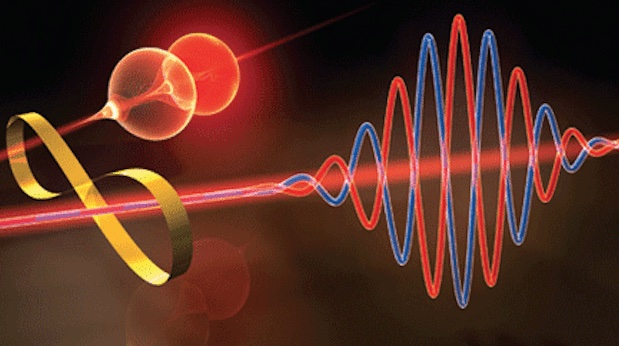
Previous activity: Hanna’s Master and PhD work at Laboratoire Kastler Brossel (group of Pr. Julien Laurat).
Hybrid quantum information processing aims at overcoming the technical difficulties inherent to each of these domains, in order to achieve more efficient and less experimentally costly protocols, towards the realization of a quantum network. A hybrid quantum network could, for example, run some of its protocols in discrete variables, where very high fidelities can be obtained, while having other protocols encoded in continuous variables, where the possibility of performing operations in a deterministic, “push-button” way would be a revolution and would allow large-scale realizations.
The first hybrid entangled state
During her Master internship, Hanna worked on a way to bridge these different domains by realizing the first “hybrid” entangled state between continuous and discrete variables, showing the possibility of performing this entanglement operation at a distance, through a channel with losses equivalent to 75 km of optical fiber. The experiment was based on two optical parametric oscillators, one generating squeezed vacuum states, the other generating photon pairs. Part of each output beam was tapped and interfered in an indistinguishable fashion; a single-photon detection on the resulting interference signal heralded the generation of the state. These results were highlighted by the journal Nature Photonics, which used the paper for its cover.
Remote generation of quantum states
During her PhD, she worked on applications of this new type of entanglement, such as the remote generation of quantum states, a crucial step in a heterogeneous network framework where different nodes operate with different encodings.
The experiment was first improved to make single-photon detection more efficient, through a collaboration with the group of Pr. Sae Woo Nam at NIST on superconducting photon detectors, demonstrating quantum detection efficiencies close to unity at 1064 nm, where they were previously limited to 20–40%. Work on the stability of the optical paths (with simple, inexpensive and robust servo techniques) also led to the generation of large squeezed optical Schrödinger-cat states with very high fidelities, at generation rates nearly 100 times higher than previous realizations (published in Physical Review Letters). It was also shown that the decoherence of quantum states can be minimized using Gaussian operations, protecting cat states from optical losses.
Quantum teleportation and EPR steering
Two further experiments were performed. The first was the remote preparation of continuous-variable quantum bits: by performing homodyne measurements on the discrete part of the hybrid entangled state, continuous qubits were generated at the other end of the optical table, with full control over the generated qubit. The second, more fundamental, concerned the nature of the entanglement itself: it violated a “steering” inequality (the Einstein–Podolsky–Rosen paradox), showing for the first time that this hybrid state exhibits what Einstein called “spooky action at a distance”. These results were published in Optica and Physical Review Letters.
At the end of the thesis, a protocol was proposed for a DV–CV converter using hybrid quantum teleportation, based on a new type of “hybrid” Bell analyzer combining single-photon detection and homodyne detection. This teleportation protocol was later extended to perform hybrid entanglement swapping between distinct and distant nodes of a quantum network, experimentally realized and published in Science Advances.
Complex hybrid entangled states
Finally, new and more complex hybrid entangled states were investigated, by increasing the dimensionality of the entanglement through multiple photon detections. This form of entanglement also resonates with Schrödinger’s famous cat gedankenexperiment: the hybrid entanglement can be seen as entanglement between microscopic degrees of freedom (single photons) and macroscopic states (fields with different phases). By tuning the squeezing of the continuous variables, the number of photons was increased in a quantum way, and various criteria of “macroscopicity” showed that states of this type are good candidates for the generation of micro–macro entangled states.